What are peptides
& WHAT DO THEY DO FOR SKIN?
Peptides
for Skin
What are peptides, and why is everyone talking about them now? This is everything you need to know about microscopic miracles, including how they’re able to teach your skin to produce more proteins, like elastin and collagen.
What Are Peptides in
Skincare and How Do They Work?

Peptides are essentially small amino acids. Think of them as the building blocks in your body that make up protein. They can mimic the protein sequences found in Collagen and Elastin, which are the proteins that keep skin looking youthful.
When Peptides sink into the skin, they can encourage the production of other proteins whose levels naturally decline with age. Peptides in skincare products often look to team up with Elastin and Collagen for anti-wrinkle effects. Elastin is responsible for softening the appearance of wrinkles, while Collagen keeps skin looking firm and plump, for a brighter and more youthful appearance.
Compared to Elastin and Collagen, the Peptide particle is much smaller, which means it can be absorbed into the skin, instead of sitting on top of it.
Are
PEPTIDES SAFE?
Our bodies naturally create Peptides, so most people can use products containing them without any issues. As we age, our bodies create less Collagen and Peptides. By applying them topically, we can help supplement what our bodies don't naturally make enough of. So, the short answer is yes: Peptides are safe.
Types of peptides
for SKIN
Although some Peptides are naturally occurring in skin cells, different versions are starting to be introduced to skincare products. Different types may offer different benefits, but their impact on skin when used in products will also be impacted by overall product formulas.
Let's meet a few members of the family…
- PolypeptideAt a molecular level, a Peptide is made up of a short string of aminos. A Polypeptide on the other hand is made up of lots of aminos, making them longer and more complex, offering multiple functions and benefits.
- Collagen PeptidesCollagen is responsible for keeping skin looking youthful, plump and healthy. Basically, it helps slow the aging process. Collagen is one of the most abundant types of protein in the body, also responsible for looking after ligament strength and bone density.
- Copper Peptideswork as antioxidants and can potentially stimulate Collagen production, improving skin firmness.

What are the benefits of
PEPTIDES FOR SKIN?

Before going into the benefits of Peptides for skin, it is imperative to understand that product benefits containing Peptides may differ. This is due to other ingredients in the formula impacting the overall efficacy. Skincare products are formulated for a specific purpose, and you should always refer to their packaging for intended use.
Depending on the type of Peptide you introduce to your skincare routine and how you do it, you may be able to enjoy some of the following benefits:
- Protection against dry skin:Peptides can help to balance moisture levels in skin, helping to prevent the appearance of dry skin
- Softening of wrinkles:By encouraging the production of Collagen, skin is plumped up to look more youthful, resulting in the appearance of wrinkles softening.
- Improved skin elasticity:By stimulating the production of Elastin, peptides allow tissues to grow stronger and become more elastic, so when they're stretched, they can return to their original firmness
Peptides in
SKINCARE
All peptides have their benefits and specific roles, but when looking for skincare including Peptides, remember they need to soak into the skin. To reap the rewards and enjoy the best results, you should be looking at serums and moisturizers with Peptides – designed to be left on to soak in, as opposed to a cleanser, which is washed away.
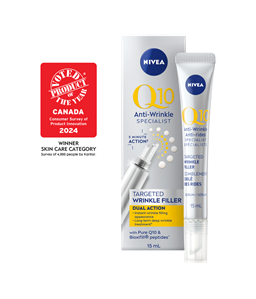
Absolutely! Peptides are small enough to penetrate the skin's surface. Our skin needs Collagen to stay strong and hydrated, but because Collagen is a large molecule, it can be difficult for traditional Collagen creams to get past the skin barrier. Products like the NIVEA Q10 Anti-Wrinkle Specialist Targeted Wrinkle Filler contain these peptides, making it much easier for your skin to absorb all the ingredients it needs to look its best.
NIVEA & Peptides:
THE INNOVATIVE FORMULA TO TARGET WRINKLES
*Temporarily visibly reduces the appearance of fine lines & wrinkles by forming a hydrating film on the skin's surface.
**With regular use.
For most effective results, use at the end of your morning and evening skincare routine in tandem with other products from the NIVEA Q10 range. Here is an example of a complete 24-hour anti-wrinkle skincare routine using NIVEA Q10 Power products, remember to thoroughly cleanse first:
Day time routine:
- Eye Cream
The NIVEA Q10 Power Anti-Wrinkle + Firming Eye Cream is specially formulated for the delicate eye area and helps to visibly reduce the look of wrinkles and dark circles under eyes, for firmer feeling skin.
- Day Cream
The NIVEA Q10 Power Anti-Wrinkle SPF 30 + Firming Moisturizer visibly reduces wrinkles in four weeks and tangibly firms your skin in 7 days while nourishing your skin for 24 hours.
- Targeted Wrinkle Filler
Apply the NIVEA Q10 Anti-Wrinkle Specialist Targeted Wrinkle Filler as the last step in your routine.


- Night time Serum
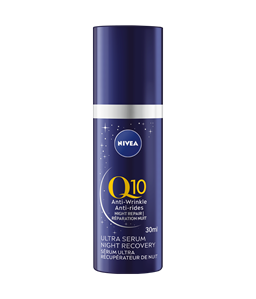
apply serum immediately after cleansing and before eye cream and night moisturizer. The NIVEA Q10 Anti-Wrinkle Night Repair Ultra Serum helps to support skin's own natural nightly repair process to reduce moisture loss and ease the appearance of wrinkles.
- Night CreamThe NIVEA Q10 Power Anti-Wrinkle + Firming Night Moisturizer intensively nourishes skin overnight, helping to visibly reduce lines and wrinkles for younger-looking skin. Apply in place of the day cream and before the NIVEA Targeted Wrinkle Filler.